Reviews by
George
10 reviews
-
 This was one of the best Executioner books I've read in a while. I tracked this early book down not too long ago and always wanted to read it. I am glad I did. This book was great because it was mostly about Bolan and what he's all about. I loved how Newton developed both Bolan, the villain and their motivations. You can tell that, of the two characters, only Bolan truly represented Justice. However, the dream sequence could have been developed better to explore Bolan's psyche. When he dreams of seeing his twin coming out of the river, there was no explanation about what that meant. Was it bolan's other half: the executioner half? Yet the dream was great reading and the scene with April Rose was not hokey at all, as some reviewers have said. A man would have memories of his loved ones deep in his mind. Bolan and the Detective: Newton did at least one other Executioner book where there was a cop who sympathized with Bolan's vigilantism. BUT this is the BEST effort of any author of any series where a detective's motivation for sympathizing with a vigilante was very well-written, interesting and believable! A great standout scene was when Al Weatherbee tells Bolan that years after his first adventure, he (Weatherbee)and his fellow cops thought about doing what Bolan did to the mafia---even though they never did. Definitely a 30-star effort from Newton.
 -
 I remember reading this as one of my early Gold Eagle readings. I was still new to the Bolan series back then. I was lucky to have come across a Mike Newton "Bolan book", since he has a grasp of the Bolan character and type of story (even though he repeated the basic plot structure over the years). I remember liking Bolan acting as a vigilante and defeating street crime (i.e. the gangs). Good seeing Bolan smash the punks! I especially liked his brief introspective musings just before he engaged the enemy during the final showdown scene. I particularly liked the fact that the cop Barney Gibson knew what Bolan was doing and approved of it, even though it was vigilante justice. It was a good post-Pendleton "introduction", for me, to the Bolan series. A good vigilante story with Bolan behaving true to form and given some depth (though not as much as in some later books).
 -
 When I first started reading the Executioner series I did not start with this first one. I started from #3 and jumped around in Pendleton's series. Then I would skip to the gold eagle versions, then back to the Pendleton series. But I was always determined to read the very first one. It was superb. What struck me about this story was the very pro-active way Bolan fought the Mafia. Its an element that does not exist to the same degree nor done the same way in the current Executioner books. Also I loved how Pendleton described Bolan's motivation for doing the things he does. Also Bolan had an assertiveness about him when he was sabotaging the Mafia's "legitimate" fronts without killing anyone. They were not battlescenes, they were just good strategies against the enemy. I especially liked the scene where Leo Turrin reveals to the Executioner that he's an undercover cop. (And I always wondered over the years how, specifically, Turrin and Bolan first realized they were on the same side). That scene also showed that Bolan is understanding enough to recognize the extenuating circumstances surrounding Turrin's undercover role in doing some of the Mafia's dirty work with the prostitution ring. The one good thing about this and other Bolan stories by Pendelton is that the mafia is not romanticized (as they are in some movies or some peoples' daily sentiments). Instead, the mafia is portrayed as they are in real life: brutal and vile, an evil to be fought. My only minor problem with this story was Sam Bolan's killing his family and himself. I could understand why Pendleton wrote it that way: he was trying to show the indirect,corruptive influence crime has on civilians. However, I think Pendleton should have kept that but also added a Mafia goon killing some of the Bolan family--just to add more believability to Bolan's initial revenge motive. Overall, a very good first adventure for Bolan and us fans.
 -
 Guenther's great characterization of Bolan, story-telling, and superb action scenes continue in this "second-parter." Two stand-out scenes: 1) the part where Bolan doesn't want the corrupt law official to be executed by a distraught Rojero. When Rojero can't bring herself to do it, she and the reader learn something about Bolan: he has standards about which method (killing or some other alternative) to use against criminals. He knows when and when not to kill, motivated by what serves Justice only. He does not commit wonton murders--that would contradict the requirements of Justice. Bolan's larger understanding of his crusade against corruption, makes him selective about killing. That's why he tries talking Rojero out of executing the villain. That's a great character-driven scene and a mark of a great writer in Guenther. The second stand-out scene near the end: the villain boasts about being a successful drug dealer telling the Executioner "there's nothing he can do about it". Then Bolan says "there is" and immediately pops the scumbag dead. Great scene! It was the type of scene that makes you say "Oh YEAH!" Overall, Bolan is portrayed as a highly mature warrior. The overall story was exciting and belivable. The bad guys and secondary good guys are portrayed without withdrawing the limelight from Bolan. Bolan remains the Alpha-Male of the story. However, Guenther could have added more variety in showing Bolan's talked-about traits: The final scene becomes the villains' attempt to exploit Bolan's concern for the innocent. However, Bolan's way of handling it merely becomes another battle scene. As I was following the story, I was expecting Guenther to have a unique scenario in which Bolan confronts the bad-guys then having to be especially clever in getting the civilians' out of harms way---and still kill the bad-guys. That would have added to the already superb Bolan characterization and the suspensfulness. Nevertheless, another 10 star effort from Guenther.
 -
 Jon Guenther does it again! His depiction of Bolan is better than in his previous books. Bolan is developed as being a very formidable an opponent to the criminals, and as being conscientious in how he fights them. Sgt. Mercy also makes his appearance. Through commentary and the viewpoints of other characters, Guenther tells us what kind of man Bolan is, then also shows us in terms of Bolan's action and attitudes. In addition, to character depiction, Guenther's story is very plausible in showing how Bolan gets his information concerning the bad-guys he must pursue. I also liked the scenes where Hal and co. try figuring out what the villains' plans are. The criminals' plot unfolds as we see it through Bolan's eyes and it pulls the reader along. The criminal plans and the danger to America is not hard to understand or follow. Further, Guenther adds a cliff hanger at the end of the novel! (A plus). One point of constructive criticism for all "Bolan" authors is : It helps if there is a deeper dimension to Bolan added. Every author should ask themselves Why Bolan feels more stongly-than-usual about doing the mission---then look deeper into Bolan's head,values, thoughts, and feelings about the situation and any personally charged events in his past that may have a bearing on the current problem, combined with a possible moral dilemma that must be resolved. Some earlier Bolan novels approximated that, but its not seen often nor fully developed. The perfect example would combine Bolan's deep concern in "American Nightmare" (w/o Bolan's loss of control and other inaccuracies), the deep character insight into Bolan as in "Eternal Triangle", the personal history of "Warrior's Revenge" and the moral dilemma of "Baltimore Trackdown" and character driven action as in "Line of Control" (only more developed)---something like that. In the meantime, since I've been reviewing the Executioner series online, "Line of Control" is the first one that gets a strong 10!
 -
 This was a great story by Guenther. Having Bolan fight terrorists and the idea of crime occuring behind the Dakar rally, were both interesting. But the thing that struck me was Jon's depiction of Bolan. The opening scene where Bolan saves the child and shoots the terrorist was done with style, showing that Bolan (unlike the terrorists)has a regard for innocent lives. Throughout the story Guenther makes an effort to show how different Bolan is from the terrorists he pursues (such as Bolan's avoidance of using biochemical weapons against the terrorists). Jon's Mack Bolan has standards--that there are some things he wont do in fighting the enemy. Later, Jon depicts Bolan as having this above-average dedication that surpasses that of ordinary spies. At another point, where Bolan confronts the woman scientist, Bolan is shown as willing to sacrifice his own life to stop the terrorists' plot. However, the only thing about Bolan that was out of character was how irritable he seemed between battles, when talking with the other characters. There was also another scene where Bolan's contact stops him from killing a terrorist by telling him that that was not the right time. Well, Bolan should be the only one making those decisions since he is the hero of the story. I'd prefer seeing him shock others by deciding when and who to kill then giving a wise (or wise aleck)one-liner why it needed to be done. In another scene, the french agent ponders why Bolan leaves her behind. Her opinions of him do not portray his actual motives. All the while, Bolan is pursuing his mission with his usual conscientiousness. I liked that as a touch of irony between the characters. Character interaction can make stories more enjoyable. Overall, an above-average Executioner story. A strong 9.
 -
 Blood and Sand was a disappointment. First here are some good points: how the action scenes were written. Some good scenes: After the FBI has their fiasco against the villains in the bldg., Mack arrives and evens out the odds. I especially liked Mack's fight on the elevator. I also thought the concept was good: that Bolan was tracking a villain who also lost his family but who, unlike Bolan, turned to crime. Negative points: However, the book did not delve too much into Bolan and Don Marqi. It never explained why each man chose different paths after having had the same family loss. There was no psychological/moral insight into why Bolan and Marqui were as they were. Consequently, there was no character depth and their actions were not character driven. THe concept had lots of potential but the author never made use of it. Also, the action scenes eventually become tiresome and boring. So boring that I decided not to read the last few chapters. A truly good Executioner book has to be more than a one-dimensional action sequence. This story could have been better.
 -
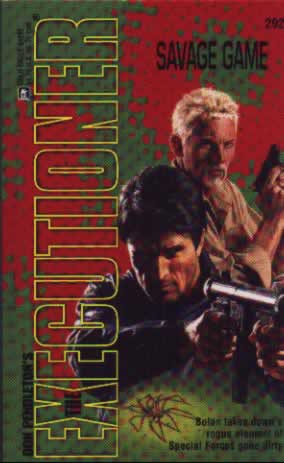 This book was intense, way better than average and kept me eagerly waiting to see what happens next. Besides being suspensful, this story showed some very masculine heroics on Bolan's part and showed them in a sequence of events that kept the story (and the character)interesting. That plus Bolan's expertise about the situation at the book's beginning, his being aware of the manipulative methods of the Club's recruitment tactics, his principled stand against the Club's Russian henchman to save Brognola's life, his psychological strength in overcoming his dire graveyard situation and Bolan's reducing Iceman to emotional weakness during the final fight scene--all of that was an excellent depiction of Bolan as a character supported by top notch writing (with an unconventional ending, too). The negative points: the graveyard scene has Bolan suppressing a scream. A battle hardened Executioner whose witnessed the brutal methods of the Vietcong and the mafia is not going to be reduced to near-screaming. True Bolan would feel fear and tenseness but near screaming seems out of character for Bolan. The second scene where the helicopter crashes in the woods sees Bolan giving in to temporary resignation which is also out of character for Bolan. Since Don Pendleton, Mack has always been determined to kill as many bad guys as he can even when his own life is about to be killed by them. Chuck would have done better had he shown Bolan being resolved to go down fighting. And the third scene that contradicted what Bolan is, was Chuck's making Mack consider his war's end a blessing when Ice pretends he's going to shoot him to death. In actuality, Bolan would never consider his (meaningful) war's end a blessing. Bolan would look upon his life and war without regrets. These points make me deduct 1 star from my rating. However, "Savage Game's" good pts greatly outweigh the bad ones. Whenever Bolan is pitted against his doppelgangers (Ice in "Savage Game" or Don Marqui in "Blood&Sand") I am always dismayed by the lack of character depth. Those types of stories should show what makes Bolan Good and his nemisis evil and why/how they choose different paths in regards to similar situations or backgrounds. Then all that must be interweaved with Bolan's and the villain's actions, so that the actions are character-driven.(No extra stars deducted here since, Chuck can't be expected to incorporate EVERYTHING into a book that is not a SuperBolan or a trilogy. Besides, his depiction of Bolan and writing make this an exciting read).
 -
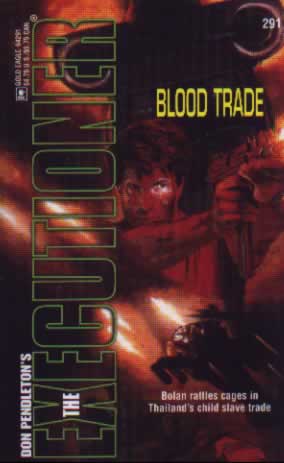 Dougs book "BLood Trade" was interesting and exciting--much better than average. Some of the good points:1)Doug gives Bolan witty one-liners just before or after shooting one of the bad guys. One of mulitple examples is how Doug wrote Bolan's response to a villain's asking "Who are you to judge me?" Doug makes Bolan's response clever, witty and indicative of what Mack is to the villians since D.Pendleton 2)Doug pays attention to the secondary characters without ignoring Bolan (though I did think he should have been more persistent in focusing on Bolan as a character). 3)I like the small look into Grimaldi's mind PLUS the feelings of friendship that are expressed between Mack and Grimaldi. Its about time we've seen good character interaction involving the main hero (Bolan) and his comrades. This also holds true for the slightly more humorous interplay between Bolan and his pal Carl Lyons earlier in the book. 4)Instead of opening with the cliched first Bolan chapter, Doug showcases Mack Bolan, how he deals with the opening situation and looks at him through Yakov's eyes. 5) Mack's determination to end the slave trade and concern for the children is nicely done and shows Bolan is caring and conscientious. 6)Doug's portrayal of Bolan as tolerant towards one of the homosexual characters in the book is accurate. Having read much of the Pendleton "Bolans", Bolan IS the type to be MATURE enough to gracefully accept the different lifestyles of other human beings (so long as they don't involve crimes, of course). So Doug's portrayal of Bolan is very consistent with Don Pendleton's take on the Executioner. The only problem with the book is that Doug merely has Mack SAY he has been thinking of his sister lately. However Doug doesn't SHOW Bolan doing that. Doug could have taken us deep into Bolan's memories of his sister and show how it enables him to select certain approaches to the current problem and how it motivates him to continue the fight. More indepth character study was needed here which is why I withold an extra star. The strong vigilante theme was great, the moralizing fantastic. Overall a good read.
 -
 This book was one of my favorite Executioner books. The mention of the Thule Order bought some historical realism to the story, thereby bringing Bolan more into the real world as he is supposed to be. The spiritual connection of Bolan to the DAG was also well done. Though Heine was fascinated with it it seems more fitting that America's quintessential warrior (Bolan)have a spiritual link to an artifact. The Hospital Battle scene was very good. It showed how Bolan's tactics indirectly reduce the odds in favor of law enforcment (i.e. the cops caught in the stand-off with the villians Bolan was fighting). I liked the idea of Bolan moving in alone to take down the villains in an exciting way. The dialogue was also superb. The words between bolan and the other characters reinforced (with style)how bolan looks at the situation and what his job is. I disagree with EricNY about Bolan's having every answer "annoying". I loved that particular thing about Bolan as it showed him having an expert's understanding of the situation that none of the other characters had. That's how a hero should be portrayed:wiser and more in control of the situation than the other characters. This story gets a strong 9!